


Building Confidence, Resilience and a Life You Value
There’s a moment that happens dozens of times a day — so quickly you might not even notice it. Something happens. A difficult email lands. A conversation goes sideways. A deadline looms. A feeling rises that you’d rather not feel. And in that fraction of a second, before conscious thought has fully arrived, you’re already moving.
The question is: which direction?
This is what’s called a Choice Point — a concept drawn from ACT (Acceptance and Commitment Therapy) that I’ve used in Resilience Coaching and Self Leadership Coaching for years. Not because it’s complicated, but because it’s true. And because the clients who really internalize it tend to carry it with them long after our work together ends. It becomes one of their go-to tools, kind of an inner compass.
The idea is simple, even if the practice isn’t. In any given moment, your actions are either moving you Towards — towards your values, towards the kind of person you want to be, towards the life you’re genuinely trying to build — or they’re moving you Away. Away from discomfort, away from difficulty, away from whatever feels threatening or overwhelming in that moment. Away, ultimately, from yourself.
Both directions are human. Neither is a moral failing. But only one of them compounds in your favor over time.
The Pull of the Away Move
Away moves aren’t random. They’re not laziness or weakness or character flaws. They’re responses — often deeply intelligent ones — to the experience of discomfort. Your nervous system registers something as threatening, and it moves to protect you. Sometimes that looks like avoidance. Sometimes procrastination. Sometimes it’s over-explaining, people-pleasing, scrolling, overworking, withdrawing, or keeping the peace when speaking up would serve you better.
The problem isn’t that Away moves exist. The problem is that they so often happen on autopilot — reflexively, habitually, without any real choosing involved. You’re hooked before you know it. The trigger hits, the familiar pattern activates, and the moment of genuine choice slips by unnoticed.
And if it happens enough times, across enough moments, across enough days — the cumulative drift becomes significant. You look up one day and realize you’ve been organizing your life around avoiding discomfort rather than moving towards what matters. That gap between who you are and who you want to be doesn’t appear all at once. It widens slowly, one unconscious Away move at a time.
What a Towards Move Actually Is
A Towards move isn’t about being positive. It isn’t about pushing through, toughing it out, or pretending the discomfort isn’t there. It’s not heroic. Most of the time, it’s quiet.
A Towards move is simply an action — however small — that reflects your values. That moves you closer to the person you’re trying to be. That honors what actually matters to you, even when something else is pulling in the other direction.
It might be having the conversation you’ve been avoiding. It might be sitting with an uncomfortable feeling instead of numbing it. It might be choosing rest when you’ve been conditioned to believe that rest is giving up. It might be saying no when yes would be easier but dishonest.
The size of the move is almost irrelevant. What matters is the direction. Even a modest, micro-step towards your values does something that an Away move never can — it builds. It reinforces. It tells a part of you that you can be trusted, that your choices reflect who you are. Over time, that accumulation becomes the foundation of genuine confidence and resilience — not the performance of those things, but the real article.
The Squiggly Line
If you’ve seen the image of this article (not the choice point below), you’ll notice the lines aren’t straight. They’re squiggly — deliberately so. Because this isn’t a model that promises clean, linear progress. Life is messier than that, and any framework that pretends otherwise is selling you something.
You’ll make Away moves. So will I. So will everyone who’s ever seriously tried to live by their values. The squiggly line isn’t a sign of failure — it’s an honest representation of what conscious living actually looks like. Two steps towards, one step sideways, a stumble back, then forward again. The practice isn’t perfection. It’s awareness. It’s returning.
What shifts over time isn’t that Away moves disappear. It’s that you catch them sooner. The gap between trigger and response widens. You develop what might be called a kind of inner weather awareness — you notice the pull before you’re already gone. And in that noticing, choice becomes possible again.
Working With the Choice Point
This is where the worksheet comes in — not as an academic exercise, but as a living practice. Something to return to when the autopilot has been running the show and you’re ready to take the wheel back.
Here’s how to use it:
Identify the Choice Point. Notice when you’re at one — a moment where you feel the pull in two directions. It doesn’t have to be dramatic. Stress about a deadline. Tension before a hard conversation. The impulse to scroll instead of rest. These are all Choice Points.
Map your moves. On one side, the Away moves — the actions or reactions that lead you from your values. Procrastination. Avoidance. Self-criticism. Over-explaining. Shutting down. On the other side, the Towards moves — the actions, however small, that honor what you actually care about and reflect the person you want to be.
Notice your triggers. What hooks you? Is it a specific thought, a feeling in your body, a particular kind of situation? Understanding your triggers is what transforms a reactive pattern into a recognized one — and recognized patterns lose some of their grip.
Create a pause. Mindful awareness isn’t complicated. It’s just the practice of catching yourself before you’re already moving. A breath. A brief moment of stillness. HeartMath coherence practice. Whatever creates the gap between stimulus and response — that gap is where your agency lives.
Commit to small, consistent Towards moves. Not transformation. Not perfection. Just one more conscious choice than yesterday. Each one reinforces the next. Each one tells you something true about who you are.
Be honest and kind with yourself. Self-compassion here isn’t soft — it’s strategic. Harsh self-judgment after an Away move almost always produces another Away move. Kindness creates the conditions for trying again.
A Question Worth Sitting With
If you mapped your last week — not the version you’d like to believe, but the actual one — what pattern would you see? How often were your choices genuinely moving you towards your values? How often were they moving you away from discomfort, which isn’t quite the same thing?
There’s no judgment in that question. Only information. And information, if you’re willing to look at it honestly, is where change begins.
The Choice Point doesn’t ask you to be different. It asks you to be more awake to the choices you’re already making — and to recognize that in any given moment, a different direction is possible.
Away or Towards. You get to choose.
Want to work with this directly? Save a copy of the Choice Point Worksheet below — a simple, practical tool to help you map your moves, recognize your triggers, and make more intentional, values-aligned choices. Use it alone, with a coach, or bring it into a conversation that matters.
And if you’re curious about what your Towards moves are actually pointing towards — your deeper values, the ones that make a life feel meaningful — the Heart of Values workbook was built for exactly that.
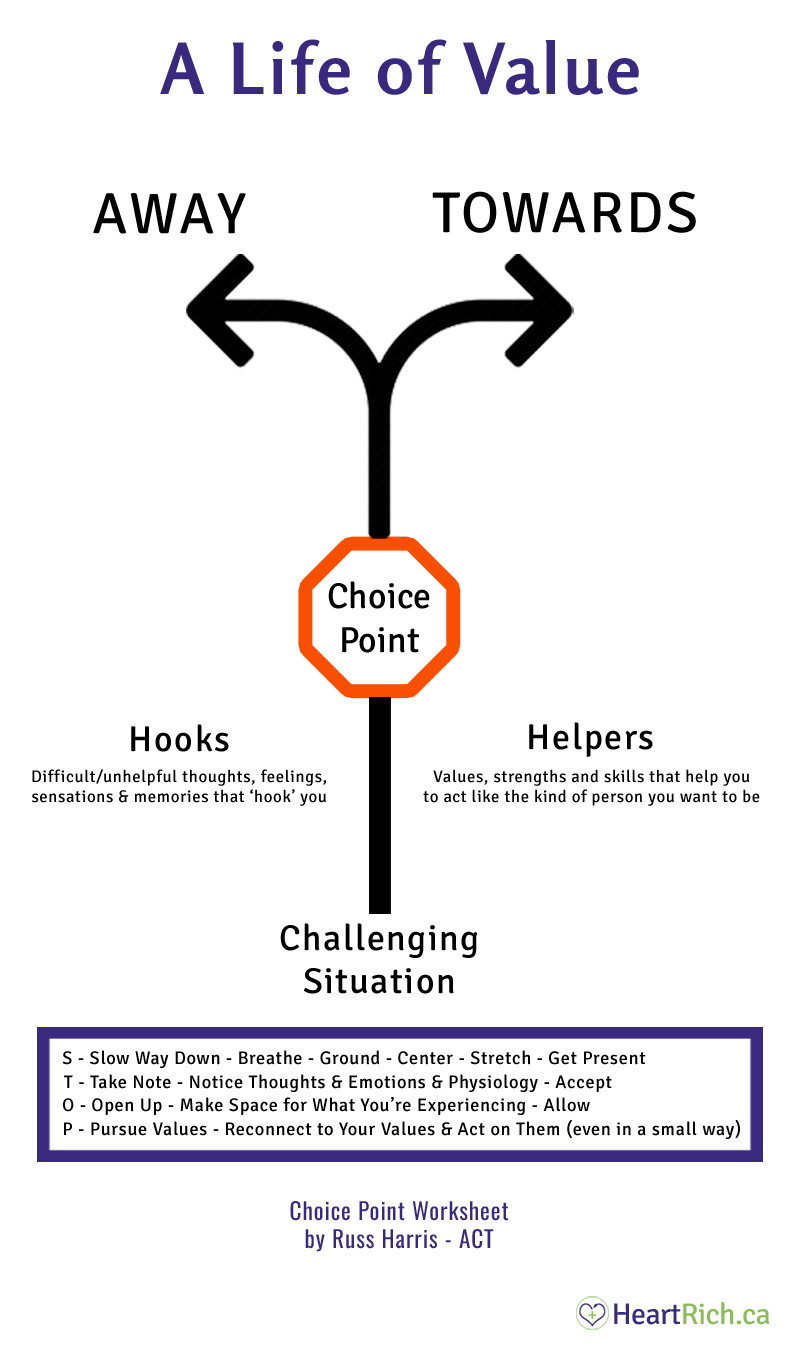
Since writing this post, I’ve blended the Choice Point model into the HeartRich Self Leadership Framework and stretched it out — creating a fuller map of what actually lives in The Space between stimulus and response, making the practice more workable in real moments, not just in reflection afterward. If you’d like the expanded version — including a free downloadable guide — it’s here: Expanding the Choice Point
Self Leadership Assessment
Curious about those away moves?
If something in this piece resonated — those unconscious away moves, the procrastination, the moments you forgot to choose, those patterns you recognize but can’t quite shake — the Who’s On Your Crew? Assessment was built for exactly this. I personally review your responses and prepare a detailed, personalized report — usually within a day or two. It’s free. And it might be the most useful thing you read about yourself this year.
Guy Reichard is a Self Leadership and Resilience Coach and the founder of HeartRich Coaching. He is the author of How to Talk Amongst Your Selves and The Heart of Values. If this resonated, you might start with the free Inner Crews Guide or the Who’s On Your Crew? Assessment.



0 Comments