

The patterns you bring to relationships are often invisible — here’s the map to find your way to healthy connection.
Most of us think of our relational patterns as personality. The way we show up in conflict, in intimacy, in the pressure of a difficult conversation — we tend to experience these as simply who we are. Not as patterns we developed. Not as strategies we learned. Just as us.
That assumption is both understandable and costly. Because patterns, unlike personality, can change. But only if we can first see them — clearly, honestly, and without the kind of self-judgment that makes honest seeing almost impossible.
One of the most useful tools I’ve encountered for that kind of seeing — and one I share regularly with coaching clients — is the Relational Grid, developed by therapist and author Terry Real. Real introduced it in the context of relationship therapy, drawing on the work of Pia Mellody on codependency and relational wounding. I’ve found it equally illuminating in everyday coaching and leadership contexts, where the same dynamics play out constantly, often invisibly.
The question the grid invites is simple: How’s my relating? It sounds almost too simple. But sitting with it honestly — in the middle of a charged conversation, in the wake of a conflict, in the quiet of self-reflection — can be genuinely revelatory.
The Architecture of the Grid
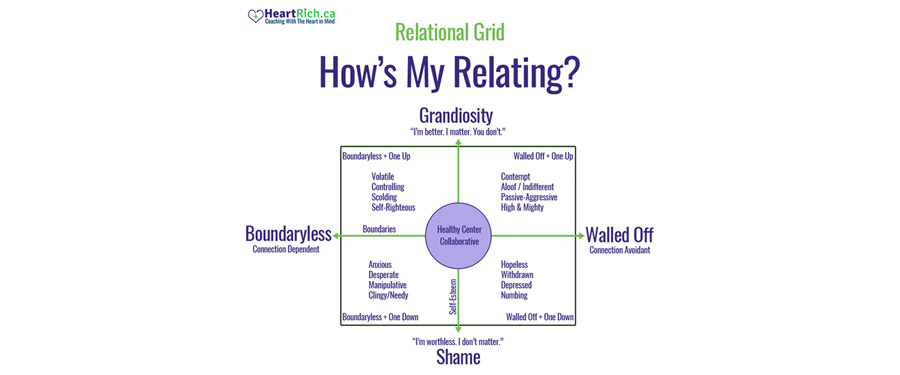
The Relational Grid maps two axes of relational experience — self-esteem and boundaries — and the four quadrants that emerge from their intersection.
The vertical axis is self-esteem — specifically, how we hold ourselves in relation to others. At one extreme is grandiosity: the One Up position, where I am better, more important, more worthy of consideration than you. At the other is shame: the One Down position, where I am less than, worthless, not worth taking seriously — including by myself.
The horizontal axis is boundaries — how open or closed we are to genuine connection. At one extreme is boundarylessness: saying and doing whatever we feel, without filter or containment, spilling into others’ space uninvited. At the other is being walled off: locked down, defended, avoiding real contact, keeping others safely at arm’s length.
At the center of the grid — where neither axis dominates — is the Healthy Collaborative Center: healthy self-esteem that holds both yourself and others with genuine regard, combined with boundaries that are both protective (setting your limits with others) and containing (keeping in what would be unnecessarily hurtful or violating).
That center is not a fixed destination. It’s an orientation we move toward — and away from — depending on the situation, the relationship, the stress level, and how much of our own inner work we’ve done.
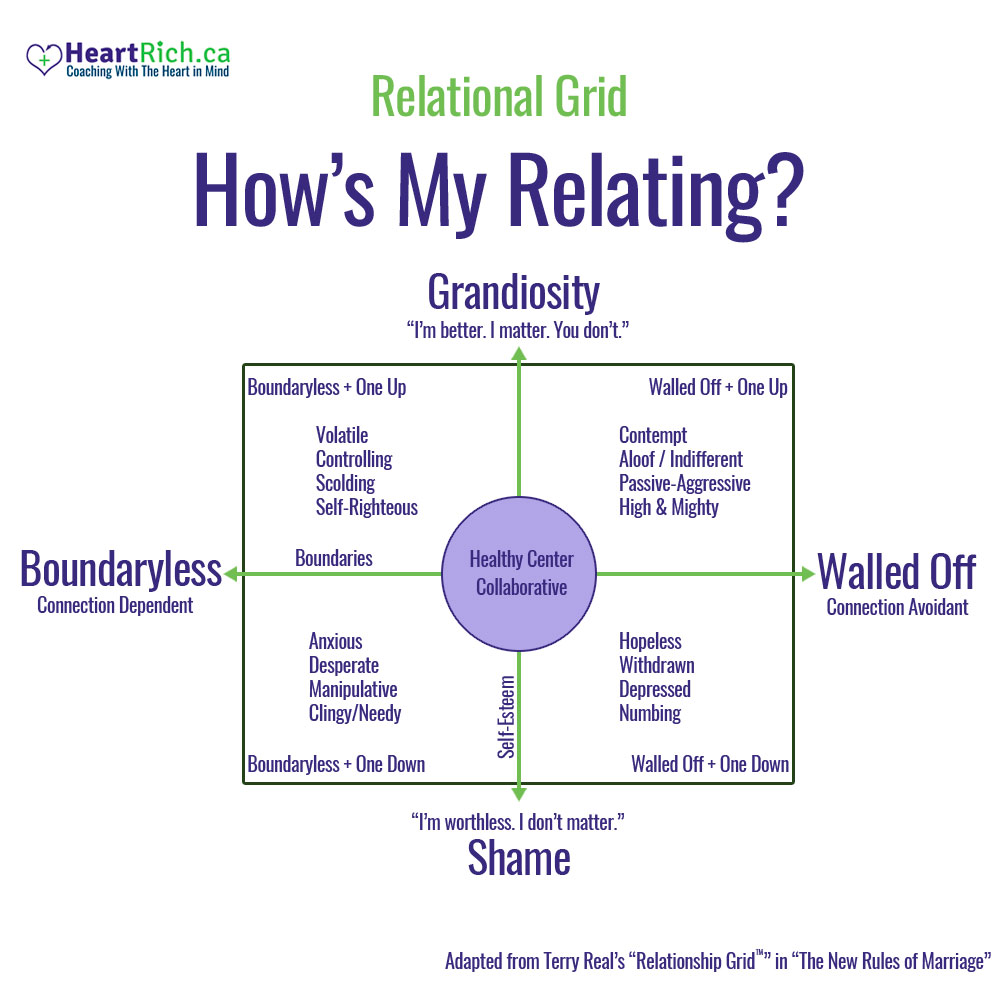
[Relational Grid diagram — Terry Real, adapted by HeartRich]
The Four Quadrants
Each quadrant represents a recognizable relational orientation — a combination of self-esteem position and boundary style that produces a predictable pattern of behavior. None of these are fixed identities. Most of us move between quadrants depending on context, relationship, and the degree to which we’re triggered.
Boundaryless + One Up
Volatile · Controlling · Self-Righteous
The orientation of someone who believes they’re right, they know best, and they have the standing to tell you so — at length, and without much filter. This can look like rage, lecturing, scolding, or the particular exhausting quality of someone who is perpetually certain. At its extreme: the volatile, controlling person who dominates through emotional force.
Walled Off + One Up
Contemptuous · Aloof · High & Mighty
The orientation of someone who holds themselves above others but expresses it through distance rather than dominance. Contempt, indifference, passive aggression, a studied aloofness that communicates: you are not worth my genuine engagement. This can look extremely composed on the outside. It is a defense, not a strength.
Boundaryless + One Down
Anxious · Desperate · People-Pleasing
The orientation of someone who needs connection so urgently — and feels so insufficient on their own — that they overflow into others’ space trying to secure it. Clingy, people-pleasing, manipulative through need rather than dominance. This is the quadrant of the chronic over-giver who has forgotten, or never learned, that their needs matter too. (Read more: Boundary Setting for the Boundary-Challenged)
Walled Off + One Down
Hopeless · Withdrawn · Depressed
The orientation of someone who has both given up on themselves and withdrawn from others. Numbing, depression, hopelessness, going through the motions of life without genuine engagement. This quadrant often follows extended periods in other quadrants — it is what burnout and chronic shame can eventually produce. (Read more: Burnout Is Not a Badge of Honor)
A few important things to notice about these quadrants. First: none of them are fixed identities. You might be One Up with a direct report and One Down with your partner. Boundaryless with your mother and walled off with a colleague who reminds you of someone who once hurt you. The grid shifts with context, relationship, and stress level.
Second: One Up and One Down are two expressions of the same underlying wound. Grandiosity is often shame wearing armor. The person who dominates and the person who shrinks are frequently operating from the same core belief — I am not enough as I am — expressed in opposite directions. In IFS terms, these are protective parts doing their jobs. In HeartRich terms, this is unenoughness in action. (Read more: Reframing Impostor Syndrome)
Grandiosity is often shame wearing armor. One Up and One Down are two expressions of the same wound.
Where I’ve Lived on the Grid
I’m not going to pretend I’ve always operated from the Healthy Collaborative Center. I’ve lived in multiple quadrants at different points in my life — and I still visit them, especially under stress.
A familiar default, I’ve visited often in my life, has been Walled Off + One Down — the quiet withdrawal, the going-through-the-motions, the depression that follows disconnection from needs and emotions. The numb escape that feels safer than the alternative.
But I’ve also had some One Up moments — some self-righteous certainty, the swing from not standing up for myself to going too far, the way anxiety and unmet needs can turn, under pressure, into control. I recognized myself in Terry Real’s framework the way you recognize yourself in something you’d rather not have confirmed.
That recognition — uncomfortable as it was — was genuinely useful. Not because it made me feel bad about myself, but because it gave me something to work with. A map. A question I could actually ask in real time: Where am I right now? And is this where I want to be?
That’s the practice the grid makes possible. Not self-criticism — self-awareness. And self-awareness, as I tell every client I work with, is where the power and responsibility to choose begins.
What Drives the Quadrants
Understanding where you tend to land on the grid is useful. Understanding why is transformative.
Our relational patterns don’t appear from nowhere. They were formed in response to real experiences — in the environments we grew up in, in the relationships where we first learned whether our needs would be met or denied, whether expressing ourselves was safe or dangerous, whether we were fundamentally worthy of love or fundamentally at risk of losing it.
In the language of Self Leadership and IFS, our quadrant patterns are the behavior of our Protective Parts — the Managers and Relievers who developed strategies to keep us safe, connected, or at least functional in environments that weren’t always safe or reliable. The people-pleaser in the One Down quadrant isn’t weak. They’re protected. The controller in the One Up quadrant isn’t strong. They’re defended.
Which means the path toward the Healthy Collaborative Center isn’t primarily about behavior change. It’s about understanding what the pattern is protecting — and gradually creating the inner safety and more effective (updated) ways of meeting our needs, that makes the protection less necessary.
(Read more: What Is Self Leadership? · The Inner Crews · It’s Time We Talk About Trauma)
Using the Grid in Real Time
The most practical thing about the Relational Grid is the question it generates: How’s my relating right now?
You can ask it in the middle of a conversation. In the car on the way home from a difficult meeting. After a conflict with someone you care about. Before a hard conversation you’ve been avoiding.
The Relational Self-Check
In this moment, in this relationship, am I:
One Up? Feeling superior, certain, dismissive, controlling, or self-righteous? Is my energy trying to dominate this interaction?
One Down? Feeling inferior, helpless, ashamed, or unworthy? Am I shrinking, appeasing, or going along with something that doesn’t actually work for me?
Boundaryless? Am I saying or doing things without filter — spilling my activation into this person’s space without their invitation?
Walled Off? Have I gone behind glass — physically present but internally absent, defended, or disconnected?
At center? Am I genuinely present — holding both myself and this person with respect, with open and contained boundaries, with the capacity to connect without losing myself?
The goal isn’t to always be at center — that’s not realistic, especially under stress. The goal is to notice when you’re not, and to have enough self-awareness to make a choice about it. That noticing — that pause between stimulus and response — is where Self Leadership lives.
Over time, with consistent practice and genuine inner work, the center becomes more accessible. Not because you’ve perfected your relating — but because you’ve developed enough inner safety that the protective patterns don’t need to run the show as often or as intensely.
The Way Toward Center
Moving toward the Healthy Collaborative Center isn’t primarily a skill-building exercise. It’s an inside job. The outer work of communication and boundary-setting matters — but it rests on inner foundations: self-awareness, self-compassion, and a growing sense of genuine worth that doesn’t depend on dominating others or disappearing for them.
In coaching, I work with the Relational Grid alongside the Inner Crews framework — because the quadrant patterns are almost always the behavior of specific protective parts. Identifying which Crew is running the show in a given relationship opens the door to understanding what it’s protecting, what wound it formed around, and what would need to be different for it to trust that it doesn’t need to lead anymore.
That work takes honesty. It takes humility. It takes something greater than strength or humility. It takes love. For yourself first. And then, from that foundation, for the people you’re in relationship with.
Because healthy relating isn’t something you perform. It’s something you become capable of — as you become more fully yourself.
The next time you feel activated in a relationship — tightening, rising, shrinking, withdrawing — try pausing long enough to ask the question: Where am I on the grid right now?
That one question, asked honestly, is the beginning of something different.
Continue Reading
What Is Self Leadership?
Boundary Setting for the Boundary-Challenged
The Inner Crews
Reframing Impostor Syndrome
The APPS MAP: Upgrading Your Adaptive Protective Patterns
You Need to Value Your Needs & Values
Self Leadership Assessment
Wondering which Crew is running your relationships?
The patterns that show up on the Relational Grid have names. The Who’s On Your Crew? Assessment helps you identify which protective patterns are most active in you — and what they’re protecting. I personally review your responses and prepare a detailed, personalized report — usually within a day or two. It’s free.


Great article. Love your approach. You provided clear explanation, you offered support (coaching) and provided guidelines for clients to start the journey on their own.
Thank you, Rogena! Great to get your feedback. I hope it helps you in some way. ~ Guy