


There is a moment that happens dozens of times a day. Something arrives — an email that lands wrong, a conversation that shifts, a feeling you’d rather not have, a decision you’ve been deferring. And in the fraction of a second before conscious thought has fully formed, you are already moving. Not deciding. Moving.
The question this post is built around is a simple one: which direction — Towards or Away?
In any moment, your actions are moving you one of two ways. Towards — towards your values, your integrity, the kind of person you’re genuinely trying to be. Or Away — away from any form of discomfort. Fear, yes. But also effort, awkwardness, boredom, irritation, grief, uncertainty, the weight of something hard, or simply not wanting to.
Both directions are human. Neither is a character flaw. But only one of them compounds in your favor over time.
This is the Choice Point — a model originally developed by Russ Harris as part of Acceptance and Commitment Therapy, rooted in Viktor Frankl’s insight that between stimulus and response, there is a space. What you do with that space is where Self Leadership either shows up or goes quiet.
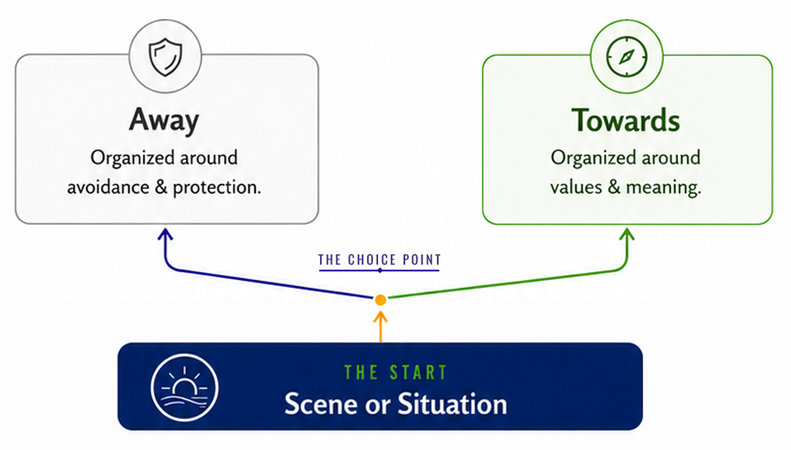
Over years of coaching, I’ve expanded the model. The original binary — Away or Towards — is real and useful. But there’s more that lives inside the moment before the move. The Impulse. The Space. The Hooks that pull at you and the Helpers available to you. That fuller picture is what this expanded version maps, and makes practisable.
The Original Choice Point — And Why It Needs Expanding
At first glance, the Choice Point looks simple: something happens, and you move Away or Towards. That clarity is genuinely useful — it names the choice that most people don’t even realize is a choice. It becomes a concept we can use and leverage throughout the coaching journey. But the space between a situation and a response is more crowded than the simple model suggests. And without understanding what’s actually happening in there, “just choose your values” can feel like good advice you can’t quite follow.
The expanded model maps the sequence more honestly.
The Choice Point doesn’t usually arrive as a calm, obvious decision. It arrives as an automatic movement — and then, if you’re paying attention, as a moment of awareness where something different becomes possible.
Here’s what actually happens between a situation and a response:
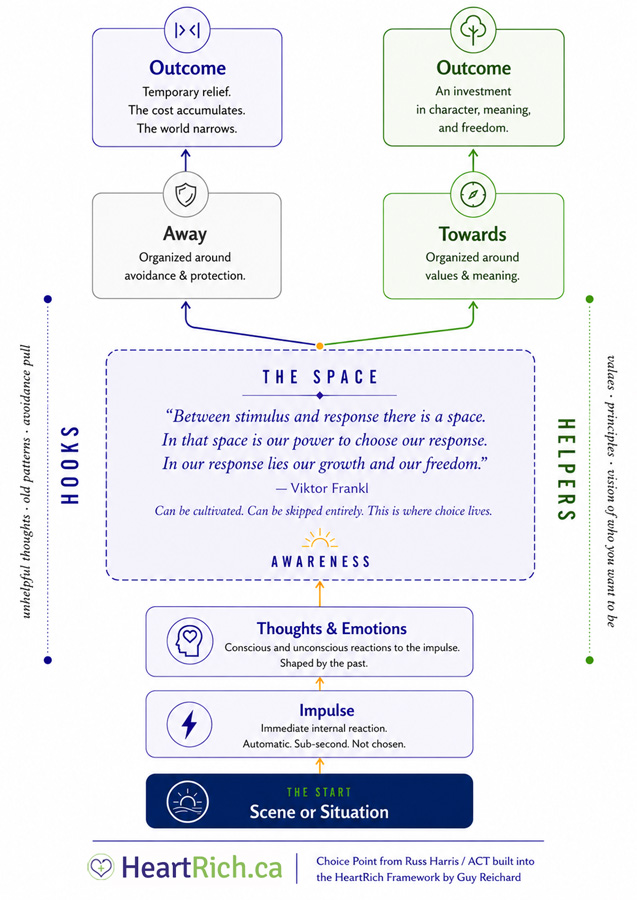
- A situation arrives. The email. The question. The silence. The look on someone’s face.
- An impulse fires. Immediate, automatic, sub-second. Before thought has fully formed, your system is already moving.
- Thoughts and emotions gather. Often shaped by old experiences, familiar fears, protective patterns, and well-worn stories about yourself, other people, or what might happen next.
- The Space appears. Sometimes wide and clear. Sometimes barely a breath. Sometimes skipped entirely. But when awareness is present — even partially — something different becomes possible.
- Hooks and Helpers become visible. The thought pulling you toward the old default. The value or commitment that has something to say. Which one you follow is the actual choice.
- The move happens. Towards or Away.
The goal of this practice is not to force yourself to make different choices. It’s to catch the moment a little earlier — so the choice that follows actually belongs to you.
Why Away Moves Exist
The Away move isn’t a character flaw. It’s a survival strategy that worked — and that your system learned to apply broadly.
We are wired to move away from pain and discomfort before conscious thought has a chance to weigh in. For most of human history, that speed was the point. Those who hesitated in the face of real danger didn’t survive long enough to pass their genes on. In that sense, you come by the Away move sincerely. It’s ancient, it’s intelligent, and it was shaped by conditions far more life-threatening than most of what you face today.
But the same system that once moved you away from genuine danger now moves you away from anything that registers as uncomfortable — and the range is far wider than most people realize. Yes, fear. But also effort. The conversation that would take something out of you. The task you keep deferring because it’s just hard. The feedback you don’t give because it would be awkward. The decision you avoid because the uncertainty is uncomfortable. None of these feel like survival. But your system treats the discomfort the same way — and without awareness, the Away move happens before you’ve even registered there was a choice.
WORTH NOTICING
The Away move isn’t a decision, most of the time. It’s a default — running quietly in the background, shaping choices you believe are yours, accumulating costs you may not notice until they’ve already been paid.
When Away moves accumulate — when they become the default response to anything uncomfortable — they begin to narrow the life around them.
Avoided conversations become unresolved tensions. Unspoken truths become distance. Deferred decisions become drift. And over time, a pattern that was built to protect you starts to shrink your world — your sense of who you are, what you’re capable of, what kind of person and leader you can be.
Research is consistent on this: chronic avoidance doesn’t reduce anxiety or distress. It relieves it briefly — and then reinforces it. The thing avoided grows in the avoiding.
The Space Between
Viktor Frankl wrote: “Between stimulus and response there is a space. In that space is our power to choose our response. In our response lies our growth and our freedom.”
That space is real. But it’s not guaranteed — and it’s not always obvious when you’re in it. For most people, most of the time, the space is so compressed that the impulse and the move feel like the same thing. The reaction seems to happen to them, not through them.
The practice of the Choice Point is, in large part, the practice of widening that space — not by eliminating the impulse, but by building enough awareness to notice it before it becomes an action.
Awareness is not a switch you flip. It is a capacity you build. Each time you catch the moment — even imperfectly, even after the fact — you are strengthening the very thing that makes choice possible.
The space doesn’t have to be long. It just has to be present enough to ask one question: Is this the move I actually want to make?
Hooks and Helpers
Inside the Space, two forces are usually at work.
Hooks
A Hook is anything that pulls you toward the Away move before you’ve fully registered there was a choice. Hooks are not malicious — they are, at their core, protective. They’re the familiar thought, the old story, the internalized voice that has kept you safe (or felt like it) before.
Common Hooks:
- “This is going to go badly.”
- “They won’t hear me anyway.”
- “I’ll do it when I feel more ready.”
- “If I say this, everything will fall apart.”
- “I’ll look incompetent / needy / too much.”
- “Just this once — I’ll deal with it later.”
Being Hooked doesn’t mean the thought is wrong. It means the thought has authority it may not deserve in this moment. You can acknowledge a Hook without obeying it.
Helpers
A Helper is any internal resource that orients you toward the Towards move — not by suppressing the discomfort, but by giving you something worth moving toward. Helpers are usually values, commitments, principles, or the vision of the kind of person you’re trying to be.
Common Helpers:
- I value honesty — even when it’s uncomfortable.
- This relationship matters enough to say the real thing.
- The version of me I respect makes this call.
- I’ve avoided this too long already.
- One conversation won’t undo everything. But not having it might.
The work isn’t about silencing the Hooks. It’s about giving the Helpers enough space to be heard alongside them.
REFLECT
Which Hooks pull hardest on you? What are the old stories your system returns to most reliably when discomfort arrives? And which Helpers have you been underusing — the values or commitments that are present, but rarely given airtime before the Away move happens?
What a Towards Move Actually Is
A Towards move is not optimism. It is not pushing through, toughing it out, or performing courage. It is not about denying that the discomfort is real.
A Towards move is simply an action — however small — that is organized around your values rather than organized around avoiding discomfort.
It might be having the conversation you’ve been deferring. It might be sitting with an uncomfortable feeling instead of numbing it. It might be saying what you actually think in a meeting where the easier path is agreement. It might be making a decision with imperfect information rather than researching indefinitely. It might be writing the first paragraph of the thing you’ve been avoiding for three weeks.
The size of the move matters far less than the direction. Each Towards move — however modest — builds something that no Away move can.
Each Towards move tells a part of you that you can be trusted, that your choices reflect who you are, that discomfort is something you can be present with without being controlled by it. Over time, that accumulation becomes the foundation of genuine confidence and resilience — not as performance, but as something earned.
And a note worth making: a conscious Away move — chosen deliberately, with full awareness of what you’re doing and why — is not a failure. Choosing rest, recovery, or safety when you genuinely know that’s what’s needed is not avoidance. It’s discernment. The distinction matters: it’s not which direction you move, but whether you’re choosing or simply reacting.
Away Moves and Towards Moves — Side by Side
| Away Moves | Towards Moves |
|---|---|
| Avoiding a difficult conversation | Having the conversation you’ve been deferring |
| Saying yes when you mean no | Expressing what you actually think and feel |
| Over-preparing to delay deciding | Trusting yourself and making timely decisions |
| Withdrawing from feedback or conflict | Facing forward to meet challenges and grow |
| Self-criticism that stops you cold | Treating yourself with respect |
| Scrolling, numbing, staying busy | Staying present and choosing more intentionally |
| Shrinking to keep the peace | Holding a position under pressure |
Working with the Choice Point — A Practice of Noticing
The goal here is not to force values-aligned action before you’ve had a chance to understand what your values actually are. That kind of pressure rarely produces lasting change — and it doesn’t need to.
What the Choice Point offers is something more fundamental: a practice of noticing.
Where do you shrink? Where do you take the easier path? Where do you avoid, appease, hide, or defer? Where does the choice slip by before you’ve caught it?
That noticing — without judgment, without pressure to be different — is where the work begins. Because once you can see the pattern clearly, you can start to ask what’s underneath it: what the Away move is protecting, what it’s costing, what a small step in a different direction might actually look like.
Clarifying your values and building Towards moves into your commitments is the longer work. Understanding which Hooks pull hardest on you, and which Helpers you’ve been underusing, is a practice that unfolds over time. But it starts here — with a moment of honest attention.
Three questions worth sitting with
- Where do I notice myself moving Away most often — and what usually triggers it?
- What is the Away move protecting me from?
- What would a one-degree Towards move look like in that moment?
The Towards move won’t always feel obvious. Sometimes you won’t fully know what it is until you’ve started moving. That’s fine. The work isn’t perfection — it’s awareness. It’s catching the moment a little sooner. It’s asking the question, even when the answer isn’t fully formed yet.
You don’t need to be fearless to make a Towards move. You just need to be awake to the fact that one is available.
A Note on the Model’s Origins
The Choice Point model was developed by Russ Harris, Ann Bailey and Joe Ciarrochi. It is heavily featured in Harris’s book, The Happiness Trap — one of the most practically useful books in the ACT tradition (Acceptance and Commitment Therapy). The quote “Between stimulus and response there is a space” is attributed to Viktor Frankl but you won’t find it phrased exactly that way in his seminal book, Man’s Search for Meaning. The expanded version and integration of concepts here are my own, developed through the HeartRich framework and refined across many years of coaching.
Free Download · HeartRich Takeaway Coaching Guide
Seizing the Moment of Choice — A Guide to Moving Towards What Matters
The HeartRich Expanded Choice Point — including the Impulse, The Space, Hooks and Helpers, and three reflection questions — in a clean, printable guide. Built for use in sessions, journaling, or quiet reflection on your own.
Coaching · Self Leadership · Resilience
If this work resonates, let’s explore what’s possible
The Choice Point is one of the entry points into the deeper work of Self Leadership — understanding what drives your protective patterns, clarifying what you actually value, and building the internal steadiness to act from that place more reliably. That’s where coaching comes in.



0 Comments