


What Your Values Are Actually For
A reflection on The Heart of Values — and why knowing your values is only the beginning.
I came to values work the hard way.
Not through a workshop or a retreat. Not because I was curious. Because I was lost — genuinely lost — and I needed something to hold onto.
Anxiety had been my companion for years. So had self-doubt, depression, and a kind of low-grade fear that followed me through decisions I should have felt good about.
I had learned, somewhere along the way, not to trust myself. I had learned to place my self-worth in other people’s hands. To ignore what I needed and what I felt in order to keep the peace, to be useful, to be respected, to achieve.
It was a formula for suffering. And for a long time, I didn’t have a better one.
Self-trust isn’t about eliminating doubt or fear. It’s about having something stronger to guide you through it.
The shift came slowly, through coaching — first as a client, then as a student of the practice. I began to work with my values not as words on a page but as anchors. Real ones. Things I could hold when the anxiety said don’t, when the fear said shrink, when exhaustion said this isn’t worth it.
My values didn’t silence the doubt. But they gave me something more reliable than confidence to orient from. They gave me a direction when nothing else was clear.
That’s what I mean when I say values can change your life. Not because they’re inspirational. Because they’re functional. Because when you actually know what matters — not abstractly, but in your body, in your choices, in the moments that cost you something — you stop being quite so lost.
The gap between knowing and living
Most people have done some version of values work. They’ve circled words on a list. They’ve taken an assessment. They’ve received a tidy report of their top five, printed it out, maybe stuck it somewhere, and then watched it slowly become wallpaper.
And nothing changed.
Not because the values were wrong. Because naming values isn’t the same as living them. Identifying with an inspiring word won’t reshape how you respond at 11pm when you’re tired, triggered, or under pressure. The gap between intellectual clarity and embodied action is where most values work quietly fails.
I’ve watched this happen with hundreds of people. The executive who knows creativity is a core value but hasn’t made something for pleasure in years. The leader who chose integrity from a list and still softens every hard truth to keep the room comfortable. The person who listed family first and is somehow always unavailable.
None of them are hypocrites. They’re human. Their protection-organized nervous systems don’t yet trust that living their values is safe. If honesty has been met with rejection, the body defaults to silence. If boundaries have led to abandonment, the body defaults to appeasement. If courage has meant humiliation, the body defaults to shrinking.
This isn’t a character flaw. It’s conditioning. And it’s workable.
Living out of alignment with your authentic values is rarely dramatic at first. It begins as a low hum — restlessness, tightness, a vague sense that something is off. Over time, that hum becomes a slow erosion of Self.
What the book is — and isn’t
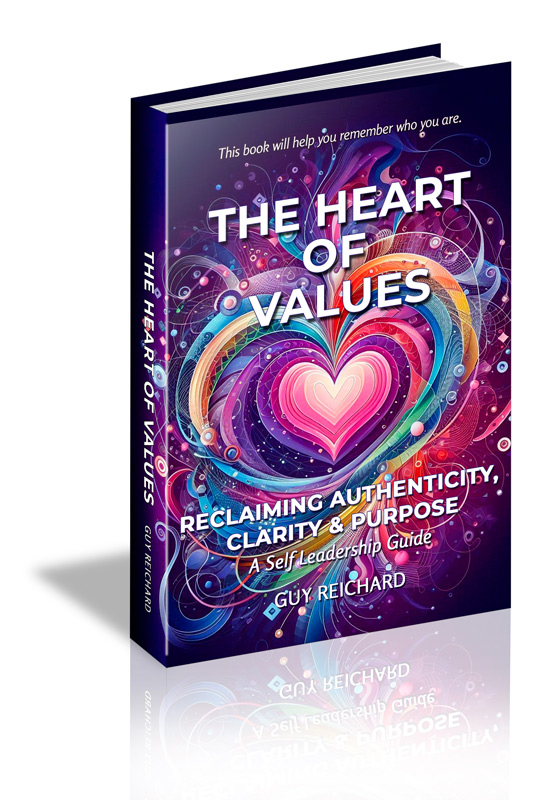
The Heart of Values started as a workbook. Over the past year I’ve continued to work with it, evolve it, elevate it and it has become something more: a Self Leadership Guide in two acts, each designed to meet the reader differently.
Part One is philosophical and reflective. It builds slowly — not toward a checklist, but toward genuine understanding. You’ll work through what values actually are and how they differ from needs. You’ll encounter a discovery process designed to move beneath the surface of what sounds right toward what’s actually true for you. You’ll learn to read your emotions as signals rather than inconveniences, and you’ll see how unmet needs often masquerade as values, quietly organizing your choices without your knowing.
There’s a chapter on purpose — not as a fixed destination but as a guiding current, a fulcrum between who you are now and who you’re becoming. There’s a framework for values-aligned communication, so you can speak from what matters rather than from what protects. And there’s a final chapter on seeing the heart of values in others — which turns out to be one of the quieter gifts of this kind of work.
Part Two is the second act, not an appendix. It’s interactive, provocative, and grounded in real practice. The Feelings Wheel. Letter assignments. A seven-day values challenge. Twenty soul-stirring provocations. Exercises that are genuinely uncomfortable in the way that growth tends to be — not cruel, but honest.
You don’t have to move through Part One before engaging Part Two. If you feel stuck, go there. Then come back. The guide will hold the thread.
What the title actually means
There’s a question I return to with almost everyone I coach: what is the one thing that will guide you through life’s hardest moments?
Not the most aspirational value. The truest one. The one that has actually shown up when things were difficult — the one that pulled you back when you were about to act in a way that wasn’t you.
For me, knowing my top value has been that. In dark moments, when I’ve felt genuinely lost, that value has been the light I could follow. Not a searchlight. More like a candle in a window. Enough to orient by.
That’s what the heart of values means. It’s not the center of a values list. It’s the living truth at the center of you — the thing your heart already knows, that your body already recognizes, that your choices already reveal, whether or not you’ve put language to it yet.
The book helps you find it. And then it helps you live from it.
Values don’t make life easier. They make it clearer. And clarity builds the kind of courage that grit alone never could.
A word before you begin
I want to say something that I mean as a genuine invitation rather than a marketing line: this guide is not for everyone.
It’s not for people looking for a quick answer, a clean identity, or a formula. It won’t hand you a tidy list and send you on your way. It will ask you to look honestly at what you’ve been living by — and to start the real work of bringing your choices into alignment with what actually matters.
That work is slower than inspiration. More uncomfortable than insight. And more durable than motivation.
I wrote it because I needed it. Because I’ve seen what happens when people do it seriously. Because I believe — and have watched this prove true again and again — that when you know your values not just as words but as a living compass, you stop asking what will keep everyone comfortable and start asking what reflects who you truly are.
That shift is quiet. And it changes everything.


0 Comments