
Values
You Might Know Your Values.
But Can You Live Them When It Matters Most?
Clarify your values so your decisions, relationships, and leadership reflect who you really are.
When Values Are Theoretical
Most people, when asked, say they know their values. They might even name a few without hesitation — family, integrity, health, honesty, freedom. Some have circled words on a list or completed a values assessment that generated a report telling them what matters most.
It feels productive. Insightful. Responsible.
But naming values isn’t the same as living them.
Picking values from a list may be a meaningful beginning, but it doesn’t create integrity. Identifying with inspiring words won’t build character. And receiving a values report won’t reshape how you respond when you’re anxious, triggered, exhausted, or under pressure.
Values clarity becomes embodied when something is at stake — when comfort and integrity pull in different directions, when living what you claim matters feels inconvenient, uncomfortable, or costly. That’s where values stop being ideas and start becoming character-building commitments.
They’re tested when honesty risks conflict. When boundaries risk disappointing someone. When rest threatens productivity. When courage unsettles comfort. When compassion challenges pride. When integrity asks you to choose long-term alignment over short-term approval.
If your values don’t meaningfully influence your decisions in moments that matter, they function more like preferences than principles. And many people live that way for years — which means there is immense depth and untapped strength still available to them.
When values move from theory to embodiment, they change more than behavior — they change direction. They simplify decisions. They strengthen courage. They increase self-trust. Each test, each challenge, each values-aligned action strengthens your inner foundation and reinforces who you are becoming.
The initial work is clarifying and prioritizing your values. The deeper work is building the capacity to live them — and to trust yourself when you do.
What Are Values, Actually?
Values are lived commitments — the principles you’re willing to organize your life around. They shape how you speak, how you decide, how you treat people, and how you treat yourself. They’re not abstract ideals. They’re deeply connected to who you really are.
When you live in alignment with your deeper values, something inside settles. You feel more coherent, more anchored, more internally congruent and fulfilled. There’s less fragmentation. Less second-guessing.
But when you drift — whether out of fear, habit, exhaustion, or external pressure — you can feel that too. Tightness. Irritation. Restlessness. A subtle sense that you’re not quite yourself. Sometimes guilt. Sometimes shame. Sometimes numbness.
Not everyone feels that misalignment immediately. Sometimes it takes years. Sometimes it shows up as burnout, resentment, quiet dissatisfaction, or a persistent sense that something is off. Living out of alignment with your authentic values is rarely dramatic at first but over time, it becomes a slow erosion of Self.
And that’s where many people begin to realize something deeper needs attention — not another productivity system, not another achievement, but a return to what truly matters.
The Gap Between Knowing and Living
You can know your values intellectually and still betray them under stress.
Why? Because your protection-organized nervous system doesn’t yet trust that living them is safe.
If your body associates honesty with rejection, you’ll default to silence — or softening the truth. If your body associates boundaries with abandonment, you’ll default to appeasement or self-erasure. If your body associates courage with humiliation or loss, you’ll default to avoidance or shrinking.
This isn’t a character flaw. It’s conditioning. And it’s workable.
Through Self Leadership Coaching, you can build the internal capacities to notice protective patterns, regulate under stress, and choose from your values rather than from fear.
Values Must Be Embodied
Values aren’t sustained by inspiration alone. They must be embodied — tested, lived, refined over time.
They require clarification and prioritization, because in real life, values compete. Honesty may compete with harmony. Ambition may compete with presence. Loyalty may compete with truth.
They require experimentation and reflection, because changing our internal map of reality — what feels safe, what feels possible, what feels necessary — happens through lived experience, not insight alone.
And they require adjustment over time. Who you are becoming may demand something different than who you once had to be. The future you want may depend on prioritizing what you’re not yet used to prioritizing. This is developmental growth — not symbolic alignment.
Self Leadership & Values
Self Leadership determines who leads within you. It is the practice of returning governance to your Authentic Self rather than to fear, habit, or protective reactivity. Your deepest values determine how that leadership expresses itself in the world.
For many, “Self” can feel abstract — a concept that sounds meaningful but remains mostly intangible. Values are different. If you know what signs to look for, they can be felt. They reveal what you love, what moves you, what angers you, what inspires you, what breaks your heart, what you would stand for, protect, build, defend, or devote yourself to.
In that sense, clarifying your values is one of the most direct ways to get to know your Self. Not because values and Self are the same thing — but because values are the visible expression of what Self cares about most. When you know what you genuinely value, you know something essential about who you are beneath the adaptations.
Explore what Self is and how access to it works → The HeartRich Matrix
When you name and prioritize them consciously, Self Leadership gains traction — not because you’re forcing discipline, but because you’re connected to something real inside you. The capacities of Self Leadership help you notice when you’ve drifted. Values help you know what you are returning to — and what you are moving toward.
Values, Needs & Emotions
The Inner Signals – How Values Become Lived
Values don’t live in isolation. They’re interwoven with your needs, your emotions, your nervous system, and your relationships.
Emotions aren’t random. They’re meaningful signals — information. When something matters to you, you feel it. When a value is honored, there’s often a sense of expansion, steadiness, or warmth. When a value is violated, there can be anger, sadness, guilt, tightness, defensiveness, or withdrawal.
Beneath those emotions are needs — for safety, dignity, respect, autonomy, belonging, meaning. Values help you interpret those signals. They give language to what your system is responding to.
If integrity matters deeply to you, you’ll feel agitation when something feels dishonest. If fairness matters, you’ll feel heat when something feels unjust. If growth matters, stagnation will feel heavy. If connection matters, emotional distance will register.
Without values awareness, emotions can seem irrational, and inconvenient. With values clarity, the information becomes more usable.
How to Speak From Your Values
This is where communication changes.
Instead of reacting defensively or aggressively, you can say: “Respect matters to me, and this crossed a line.” Instead of withdrawing, you can say: “Connection matters to me, and I’m feeling distant.” Instead of over-functioning, you can say: “Equity and fairness matter to me, and we need to recalibrate this arrangement.”
Boundaries stop feeling like acts of aggression. They become acts of integrity. Decision-making becomes less about pleasing everyone and more about true alignment.
In leadership contexts, values shape culture — not through posters on a wall, but through repeated behavior under pressure. Trust grows when values are embodied consistently. Collaboration deepens when people know what they stand for and respect what others stand for.
In personal relationships, values create certainty and safety. When your words and actions match what you claim matters, people relax. When they don’t, doubt, insecurity, and tension build.
Values, needs, and emotions aren’t separate systems. They form a living ecosystem inside you. When you ignore them, default protective intelligence organizes your behavior. When you understand and embody them, Self can lead.
Values Expand Your Range of Resilience
Strength Under Pressure
Living your values under pressure doesn’t just demonstrate character — it builds resilience.
When you choose honesty in a difficult conversation, even while anxious, your nervous system learns that conflict isn’t the end of connection. When you hold a boundary respectfully and survive the discomfort, your system updates what is safe. When you act with courage despite fear, you widen your tolerance for uncertainty.
Each values-aligned action becomes a lived experience of integrity under stress — and that experience expands your Range of Resilience. Courage becomes less theoretical and more embodied. Integrity becomes more stable under pressure. Meaning becomes fuel rather than an afterthought.
Over time, you begin to trust yourself — not because you can control every outcome, but because you know you can face what matters without abandoning who you are.
Values don’t eliminate stress. They reorganize your relationship to it.
Instead of enduring for endurance’s sake, you endure for something that matters. Instead of collapsing under pressure, you remain connected to purpose. And that connection strengthens resilience in a way that grit alone never could.
The Heart of Values
From Concept to Practice
Clarity around values rarely happens by accident — you don’t just find them one day. Values clarity requires slowing down long enough to question what you’ve inherited, what you’ve adapted to, and what actually feels true. Living them consistently requires structure and reflection.
That’s why The Heart of Values was created — not as a list to choose from, but as a structured process of reflection, clarification, and embodiment. It helps you learn how to distinguish between needs and values, explore how emotions signal alignment or misalignment, prioritize when values compete, and experiment — because values only become trustworthy when lived under pressure.
Rather than treating values as inspirational words or abstract concepts, the work treats them as lived commitments — shaping communication, decision-making, leadership, and relationships. It’s not about selecting better values. It’s about building character, authenticity, and resilience — moment to moment, season to season.
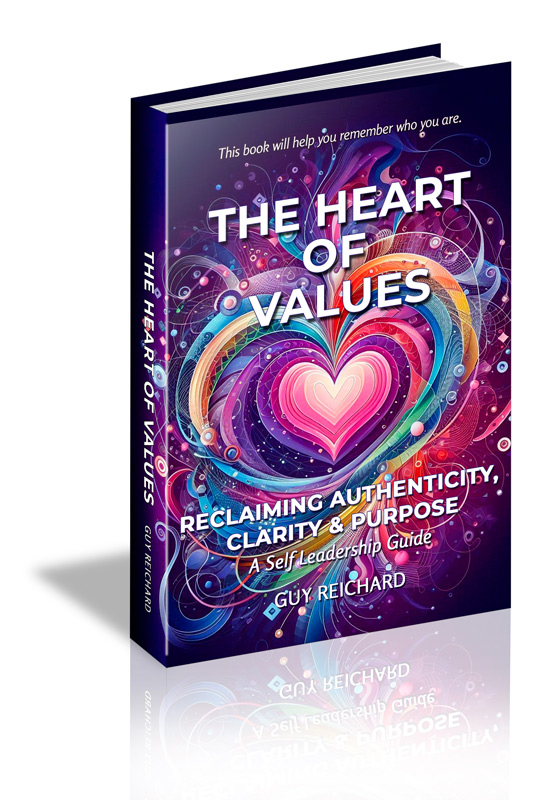
If you’re looking for a place to begin before diving into the full guide, the core values discovery guide at FindMyValues.com offers a free, structured first step — the discovery exercises, the values vs. needs distinction, and a curated set of resources. No sign-up required to read.
Where This Leads
When you’re clear about your values — and willing to live them — your life starts to reorganize.
Decision-making becomes cleaner. Energy becomes more directed. Procrastination loses some of its grip. Indecision softens. Courage becomes more available — not because fear disappears, but because something more important has taken priority.
You stop asking: “What will keep everyone comfortable?” And start asking: “What reflects who I truly am?”
You tolerate less of what erodes you. You commit more fully to what strengthens you. You build relationships rooted in honesty and mutual honor rather than strategy. You lead with integrity and heart rather than impression management.
Values don’t make life easier. They make it clearer. And clarity builds strength and confidence, which often translate into influence and impact.
Over time, that strength becomes character — not rigid, not moralistic, but grounded. You know what you stand for. You know what you won’t abandon. You know where you’re going.
If you’ve been feeling scattered, reactive, overextended, or quietly disconnected from yourself, this may not be a motivation problem. It may be a values problem. And that’s good news — because values can be clarified, embodied, and lived. Gradually, imperfectly, and with increasing integrity over time.
The work is not about becoming someone new. It’s about becoming more deliberate — and more fully yourself.
WHERE TO FROM HERE?
Start by getting to know your Inner Crews
The Who’s On Your Crew? Assessment takes about 10–15 minutes. I personally prepare your report — specific to your responses and your current context — usually within a day or two. It’s free.
OR EXPLORE AT YOUR OWN PACE
→ Read related Essays & Writing
→ Book a Coaching Exploration Session